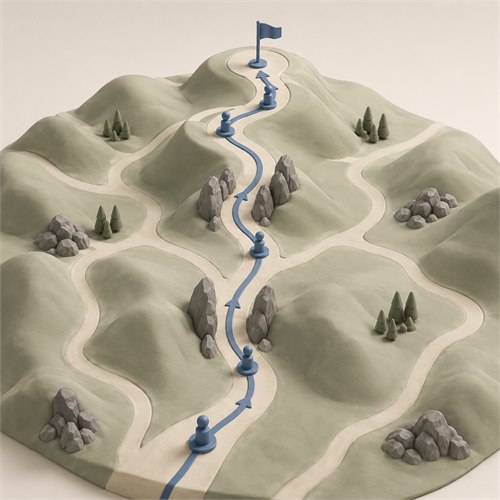
軍爭
Manoeuvring
Movement creates advantage when it turns indirect routes, timing, and deception into position.
Aliases
Manoeuvring / 軍爭 / Art of War Chapter 7
Domains
Strategy, leadership, planning, deception, competition
Chapter Focus
- Movement creates advantage when it turns indirect routes, timing, and deception into position.
- Alternate chapter title: Manoeuvring
- Chinese chapter title: 軍爭
- This chapter is grouped into three contextual rule cards while preserving the full traditional Chinese text.
Indirect Becomes Direct
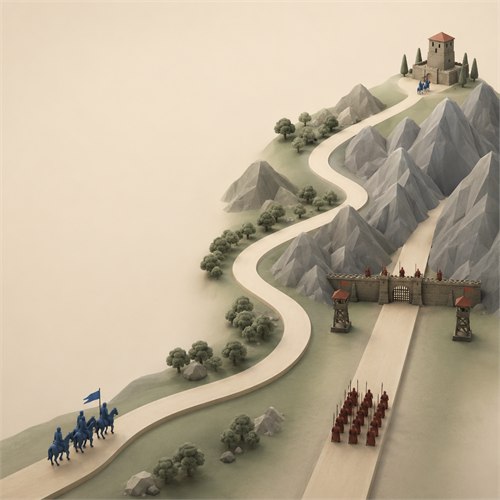
- Core idea: Turn the indirect into the direct, and turn difficulty into advantage.
- Meaning: A longer path can be the faster strategic path.
- Why it matters: Straight lines are not always the best route when the opponent is watching them.
- How to apply: Build a niche brand first if a mass-market launch would trigger stronger competitive response.
Original Text Explanation
孫子曰:凡用兵之法,將受命于君,Sun Zi says that in war the general receives command from the ruler.合軍聚眾,交和而舍,莫難于軍爭。He gathers the army, unites the host, and sets camp.軍爭之難者,以迂為直,以患為利。Nothing is harder than maneuvering. Its difficulty lies in turning the indirect into the direct and turning trouble into advantage.故迂其途,而誘之以利,後人發,先人至,此知迂直之計者也。Take a roundabout road, tempt the enemy away with profit, start after him and arrive before him: that is understanding how to turn detour into directness.故軍爭為利,軍爭為危。So maneuvering can bring advantage, but it also carries danger.舉軍而爭利,則不及﹔委軍而爭利,則輜重捐。March the full army to seize an opening and you may arrive too late; strip the force down to race for it and you may lose your baggage and stores.是故卷甲而趨,日夜不處,倍道兼行,百里而爭利,則擒三將軍,If you force-march day and night for a hundred li to snatch advantage, your field commanders may be taken.勁者先,疲者後,其法十一而至﹔The strong will push ahead, the exhausted will lag behind, and only a small fraction will reach the destination.五十里而爭利,則蹶上將軍,其法半至﹔Rush fifty li for advantage and you may lose the lead commander, with only half the force arriving.三十里而爭利,則三分之二至。Rush thirty li for advantage and perhaps two-thirds will arrive.是故軍無輜重則亡,無糧食則亡,無委積則亡。An army without baggage, food, or accumulated supplies is finished.故不知諸侯之謀者,不能豫交﹔You cannot form alliances with neighboring powers if you do not understand their intentions.不知山林、險阻、沮澤之形者,不能行軍﹔You cannot march an army if you do not know mountains, forests, dangerous passes, marshes, and swamps.不用鄉導者,不能得地利。Without local guides, you cannot take real advantage of the ground.
Deception, Advantage, and Formation
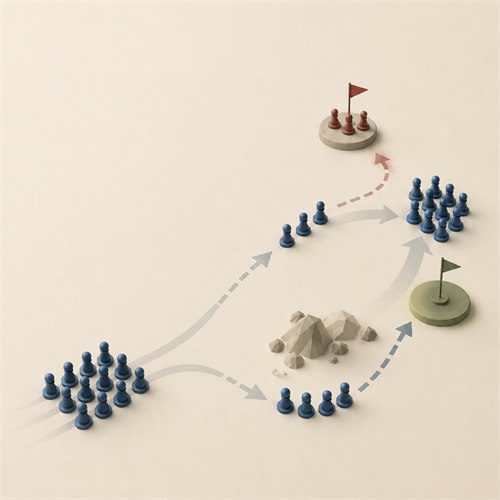
- Core idea: Armies stand through deception, move through advantage, and change through division and concentration.
- Meaning: Control appearance, incentives, and formation.
- Why it matters: Strategy is about how you show, where you move, and when you regroup.
- How to apply: Split teams for exploration, then recombine them quickly once the winning direction is clearer.
Original Text Explanation
故兵以詐立,以利動,An army stands through deception and moves for advantage.以分和為變者也。Whether it divides or combines depends on changing conditions.故其疾如風,其徐如林。Be as swift as the wind and as orderly as a forest.侵掠如火,不動如山,When raiding, burn like fire; when holding, stand like a mountain.難知如陰,動如雷震Let your hiddenness be like night, and when you move, fall like thunder.掠鄉分眾,廓地分守。When you seize supplies in the countryside, divide the gains; when you take new ground, cut it into guarded portions.懸權而動。Weigh matters carefully before you act.先知迂直之計者勝,此軍爭之法也The one who first understands how to turn detour into directness wins; that is the law of maneuvering.軍政曰:「言不相聞,故為金鼓;視而不見,故為旌旗。」The military writings say that spoken orders do not carry far enough in battle, so drums and gongs are used; eyes do not see far enough, so banners and flags are used.夫金鼓旌旗者,所以一人之耳目也;These drums, gongs, banners, and flags gather the ears and eyes of the army onto one point.人既專一,則勇者不得獨進,怯者不得獨退,此用眾之法也。Once the host is unified, the brave cannot charge off alone and the timid cannot slip away alone. That is how large forces are handled.故夜戰多火鼓,晝戰多旌旗,所以變人之耳目也。So at night rely more on fires and drums, and by day on flags and banners, to steer what the army hears and sees.
Wind, Forest, Fire, Mountain
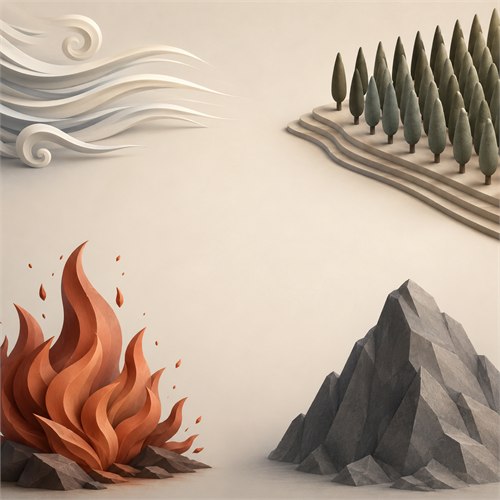
- Core idea: Be swift like wind, orderly like forest, fierce like fire, and steady like a mountain.
- Meaning: Match speed and stillness to the moment.
- Why it matters: Good operators know when to move fast and when to hold shape.
- How to apply: Execute campaigns quickly, but do not keep changing core strategy every week.
Original Text Explanation
故三軍可奪氣,將軍可奪心。The spirit of an army can be taken away, and the mind of a commander can be shaken.是故朝氣銳,晝氣惰,暮氣歸。At dawn spirit is sharp, by midday it slackens, and by evening it turns toward returning.故善用兵者,避其銳氣,擊其惰歸,此治氣者也。So the good commander avoids the enemy when spirit is keen and strikes when it droops and leans homeward. That is how morale is managed.以治待亂,以靜待嘩,此治心者也。Meet disorder with order and noise with calm. That is how the mind is managed.以近待遠,以佚待勞,以飽待飢,此治力者也。Be near while the enemy is far, rested while he labors, and fed while he hungers. That is how strength is managed.無邀正正之旗,無擊堂堂之陣,此治變者也。Do not intercept an enemy whose banners are perfectly ordered, and do not attack a force drawn up in calm confidence. That is how circumstance is managed.故用兵之法,高陵勿向,背丘勿逆,Do not advance uphill against the enemy, and do not oppose him when he comes downhill.佯北勿從,銳卒勿攻,Do not chase a retreat that is only feigned, and do not attack troops whose temper is still sharp.餌兵勿食,歸師勿遏,Do not bite on bait, and do not block an army that is returning home.圍師遺闕,窮寇勿迫,。When you surround an army, leave an opening. Do not press a desperate enemy too hard.此用兵之法也These are the working rules of war.
