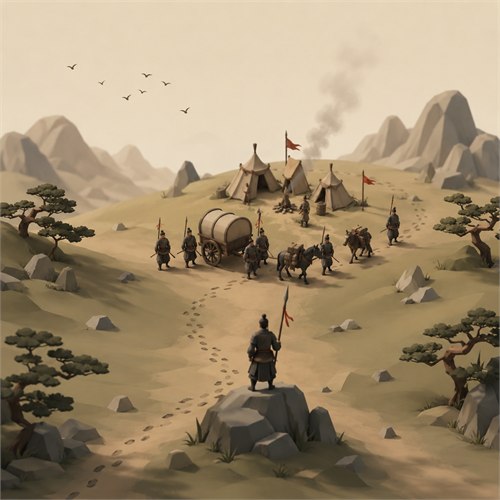
行軍
The Army on the March
Read terrain, read signs, and read morale. Observation is strategy.
Aliases
The Army on the March / 行軍 / Art of War Chapter 9
Domains
Strategy, leadership, planning, deception, competition
Chapter Focus
- Read terrain, read signs, and read morale. Observation is strategy.
- Alternate chapter title: The Army on the March
- Chinese chapter title: 行軍
- This chapter is grouped into three contextual rule cards while preserving the full traditional Chinese text.
Choose Sustaining Ground
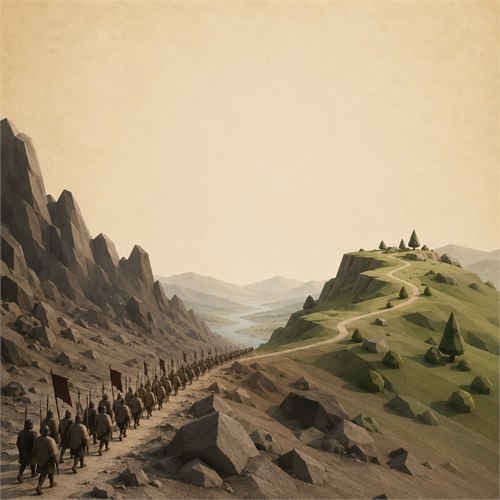
- Core idea: Cross mountains quickly, stay near valleys, and hold the high healthy ground.
- Meaning: Choose positions that sustain you.
- Why it matters: Logistics and livability matter as much as courage.
- How to apply: Put teams where communication, resourcing, and recovery are easier, not where optics merely look impressive.
Original Text Explanation
孫子曰:凡處軍、相敵,絕山依谷,Sun Zi now turns to how an army should camp and how to read the enemy's signs. Cross mountains quickly and stay near valleys.視生處高,戰隆無登,此處山之軍也。Camp on high sunny ground, and do not climb uphill to fight. That is the rule for mountains.絕水必遠水﹔After crossing a river, put distance between yourself and the water.客絕水而來,勿迎之于水內,令半濟而擊之,利﹔When an invading force is crossing a river, do not meet it in midstream. Let part of it cross, then strike.欲戰者,無附于水而迎客﹔If you want battle, do not go greet the invader right at the river he must ford.視生處高,無迎水流,此處水上之軍也。Keep your boats upstream and on the sunny side. Do not move upstream to meet the enemy. That is the rule for rivers.絕斥澤,惟亟去無留﹔When crossing marshland, your first concern is to get through it quickly without lingering.若交軍于斥澤之中,必依水草,而背眾樹,此處斥澤之軍也。If you must fight in marsh, keep water and grass near you and trees at your back. That is the rule for marshes.平陸處易,而右背高,前死後生,此處平陸之軍也。On dry level ground, choose an accessible position with rising land on your right and rear, danger ahead and safety behind. That is the rule for flat country.凡此四軍之利,黃帝之所以勝四帝也。These are four useful branches of military knowledge, and they helped the Yellow Emperor overcome several rulers.凡軍好高而惡下,貴陽而賤陰,Armies prefer high ground to low ground and sunlight to shade.養生而處實,軍無百疾,是謂必勝。If you care for the soldiers and camp on firm ground, the army avoids disease, and that helps bring victory.丘陵堤防,必處其陽,而右背之。此兵之利,地之助也。When you come to a hill or embankment, hold the sunny side with the slope on your right rear. That benefits the troops and uses the land well.上雨,水沫至,欲涉者,待其定也。If heavy rain upstream has swollen a river and filled it with foam, wait for it to subside before crossing.凡地有絕澗、天井、天牢、天羅、天陷、天隙,必亟去之,勿近也。Stay away from sheer cliffs, rushing waters between rocks, deep hollows, narrow defiles, tangled thickets, bogs, and crevasses.吾遠之,敵近之﹔吾迎之,敵背之。We should keep clear of such places and make the enemy approach them; if we face them, we should leave them at his rear.軍旁有險阻、潢井、葭葦、林木、蘙薈者,必謹慎復索之,此伏奸之所處也。If there are nearby hills, reed-filled hollows, grassy ponds, or dense woods, search them carefully, because ambushes and hidden spies favor such places.
Search Hidden Danger
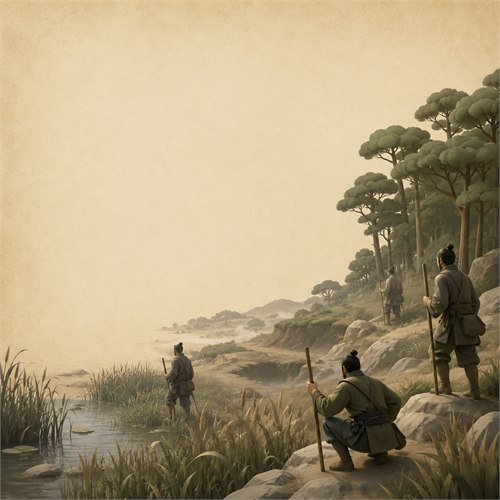
- Core idea: Search carefully wherever hidden danger could be concealed.
- Meaning: Check the places where surprise likes to hide.
- Why it matters: Risk often sits in ignored details.
- How to apply: Audit quiet dependencies, side systems, and vendor access instead of only the visible front-end product.
Original Text Explanation
敵近而靜者,恃其險也﹔If the enemy is nearby and quiet, he trusts the natural strength of his position.遠而挑戰者,欲人之進也﹔If he stays back yet keeps trying to provoke battle, he wants you to come forward.其所居易者,利也。If his camp is easy to approach, he is offering bait.眾樹動者,來也﹔眾草多障者,疑也﹔Movement through the trees shows the enemy is advancing. Artificial screens or bustle in tall grass suggest he wants to make us suspicious.鳥起者,伏也﹔獸駭者,覆也﹔Birds suddenly rising mark an ambush. Frightened animals point to an attack coming fast.塵高而銳者,車來也﹔卑而廣者,徒來也﹔散而條達者,樵采也﹔少而往來者,營軍也。A tall column of dust means chariots; low dust spread wide means infantry; dust scattered in branches means wood-gathering parties; small moving dust clouds mean the army is settling camp.辭卑而備者,進也﹔辭強而進驅者,退也﹔Humble talk paired with extra preparation means the enemy is about to advance. Violent language and a noisy show of attack often mean he plans to pull back.輕車先出其側者,陣也﹔When light chariots deploy first on the wings, the enemy is forming for battle.無約而請和者,謀也﹔Talk of peace without binding terms signals a scheme.奔走而陳兵者,期也﹔If men are running about and then falling into rank, the critical moment is near.半進半退者,誘也。If some troops advance while others retreat, it is a lure.杖而立者,飢也﹔When soldiers stand leaning on their spears, they are weakened by hunger.汲而先飲者,渴也﹔If water carriers drink first themselves, the army is thirsty.見利而不進者,勞也﹔If the enemy sees advantage and does not take it, his men are exhausted.鳥集者,虛也﹔夜呼者,恐也﹔If birds settle on a place, no one occupies it. Noise in the camp at night shows nervousness.軍擾者,將不重也﹔旌旗動者,亂也﹔吏怒者,倦也﹔If the camp is unsettled, the general's authority is weak. If banners and flags shift chaotically, disorder is rising. If officers are angry, the men are worn down.粟馬肉食,軍無懸缶而不返其舍者,窮寇也﹔When an army feeds grain to its horses, kills cattle for food, and leaves cooking pots off the fires as if it will not return to camp, it is ready to fight to the death.諄諄翕翕,徐與人言者,失眾也﹔Men whispering in small clusters and speaking in low tones show disaffection in the ranks.數賞者,窘也﹔數罰者,困也﹔Too many rewards mean the enemy's resources are nearly spent. Too many punishments mean severe distress.先暴而後畏其眾者,不精之至也﹔Blustering at first and then fearing the enemy's numbers is a mark of poor judgment.來委謝者,欲休息也。Envoys who arrive full of compliments usually signal a wish for truce.兵怒而相迎,久而不合,又不相去,必謹察之。If enemy troops come up angrily and face ours for a long time without fighting or withdrawing, the situation calls for great caution.
Read Behavior, Not Words
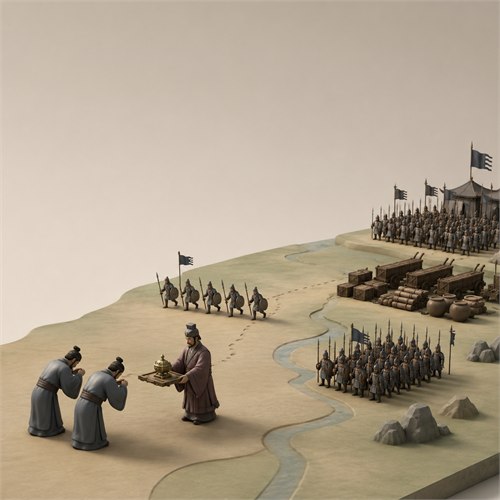
- Core idea: Humble words with stronger preparation signal attack; unprompted peace offers may be schemes; partial advance and retreat may be bait.
- Meaning: Behavior often reveals intention better than language does.
- Why it matters: Watch patterns, not claims.
- How to apply: When a competitor suddenly sounds friendly while strengthening distribution, assume preparation is underway.
Original Text Explanation
兵非貴益多也,惟無武進,足以并力、料敵、取人而已。If our troops are no more numerous than the enemy's, that is still enough. It only means we should avoid a blunt frontal attack, concentrate strength, watch carefully, and seek reinforcement.夫惟無慮而易敵者,必擒于人。Anyone who makes light of opponents and plans nothing ahead is sure to be captured by them.卒未親附而罰之,則不服,不服則難用也。卒已親附而罰不行,則不可用也。If soldiers are punished before they trust you, they will not submit. If they trust you but punishment is never enforced, they are still useless.故令之以文,齊之以武,是謂必取。So begin with humanity, but keep control with firm discipline. That is a reliable road to victory.令素行以教其民,則民服﹔令素不行以教其民,則民不服。If commands are consistently enforced in training, the army becomes disciplined. If not, discipline decays.令素行者,與眾相得也。If a general trusts his men and still insists on obedience, both sides gain.
